Cryptography Algorithms and Numericals
CRYPTOGRAPHY ALGORITHM TYPES AND NUMERICAL EXAMPLE
-
Symmetric Key Cryptography (Secret Key Cryptography)
In symmetric key cryptography, the same key is used for both encryption and decryption.
Working Principle:
Sender and receiver must share a secret key securely before communication.
Common Algorithms:
- AES (Advanced Encryption Standard)
- DES (Data Encryption Standard)
- 3DES (Triple DES)
- Blowfish
- RC4
COMPARISON TABLE
|
Algorithm |
Key Size |
Encryption Speed |
Security Level |
Advantages |
Limitations |
Common Applications |
|
AES |
128 / 192 / 256 bits |
Very Fast |
Very High |
Strong security, efficient |
Key sharing issue |
Disk encryption, VPNs, TLS |
|
DES |
56 bits |
Fast |
Low (Weak) |
Simple to implement |
Easily breakable |
Legacy systems |
|
3DES |
112 / 168 bits |
Slow |
Moderate |
Better than DES |
Performance overhead |
Banking systems |
|
Blowfish |
32–448 bits |
Fast |
High |
Flexible key size |
Not ideal for large files |
Secure file storage |
|
RC4 |
40–2048 bits |
Very Fast |
Low |
Simple, fast |
Vulnerable to attacks |
Deprecated in TLS |
-
Asymmetric Key Cryptography (Public Key Cryptography)
Uses two different keys:
- Public Key (for encryption)
- Private Key (for decryption)
Working Principle:
Public key is shared openly, while private key is kept secret.
Common Algorithms:
- RSA (Rivest–Shamir–Adleman)
- ECC (Elliptic Curve Cryptography)
- DSA (Digital Signature Algorithm)
- ElGamal
Advantages:
- Solves key distribution problem
- Enables digital signatures
COMPARISON TABLE
|
Algorithm |
Key Pair Used |
Key Size |
Encryption Speed |
Security Level |
Advantages |
Common Applications |
|
RSA |
Public & Private |
1024–4096 bits |
Slow |
High |
Widely supported |
SSL/TLS, email security |
|
ECC |
Public & Private |
160–521 bits |
Faster than RSA |
Very High |
Strong security with small keys |
Mobile, IoT, blockchain |
|
DSA |
Public & Private |
1024–3072 bits |
Moderate |
High |
Digital signatures |
Authentication systems |
|
ElGamal |
Public & Private |
Variable |
Slow |
High |
Secure randomness |
Secure messaging |
|
ECDSA |
Public & Private |
256 bits |
Fast |
Very High |
Efficient digital signatures |
Cryptocurrencies |
NUMERICAL EXAMPLE OF SYMMETRIC ALGORITHM
RSA ALGORITHM
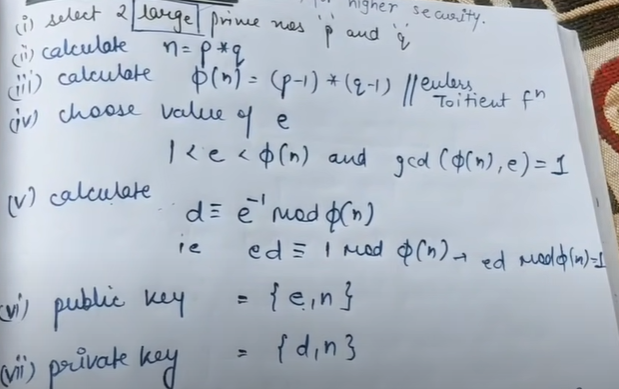
RSA algorithm is a public key encryption technique and is considered as the most secure way of encryption. It was invented by Rivest, Shamir and Adleman in 1978 and hence named RSA algorithm.
You will have to go through the following steps to work on RSA algorithm −
Step 1: Generate the RSA modulus
The initial procedure begins with selection of two prime numbers namely p and q, and then calculating their product N, as shown −
N=p*q
Here, let N be the specified large number.
Step 2: Derived Number (e)
Consider number e as a derived number which should be greater than 1 and less than (p-1) and (q-1). The primary condition will be that there should be no common factor of (p-1) and (q-1) except 1
Step 3: Public key
The specified pair of numbers n and e forms the RSA public key and it is made public.
Step 4: Private Key
Private Key d is calculated from the numbers p, q and e. The mathematical relationship between the numbers is as follows −
ed = 1 mod (p-1) (q-1)
The above formula is the basic formula for Extended Euclidean Algorithm, which takes p and q as the input parameters.
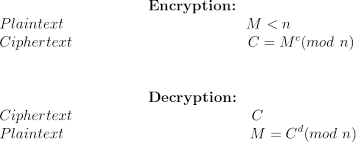
Encryption Formula
Consider a sender who sends the plain text message to someone whose public key is (n,e). To encrypt the plain text message in the given scenario, use the following syntax −
C = P^e mod n
Decryption Formula
The decryption process is very straightforward and includes analytics for calculation in a systematic approach. Considering receiver C has the private key d, the result modulus will be calculated as −
Plaintext = C^d mod n
EXAMPLE:
- Choose p = 3 and q = 11
- Compute n = p * q = 3 * 11 = 33
- Compute φ(n) = (p - 1) * (q - 1) = 2 * 10 = 20
- Choose e such that 1 < e < φ(n) and e and φ (n) are coprime. Let e = 7
- Compute a value for d such that (d * e) % φ(n) = 1. One solution is d = 3 [(3 * 7) % 20 = 1]
- Public key is (e, n) => (7, 33)
- Private key is (d, n) => (3, 33)
- The encryption of m = 2 is c = 27 % 33 = 29
- The decryption of c = 29 is m = 293 % 33 = 2
QUESTION:
